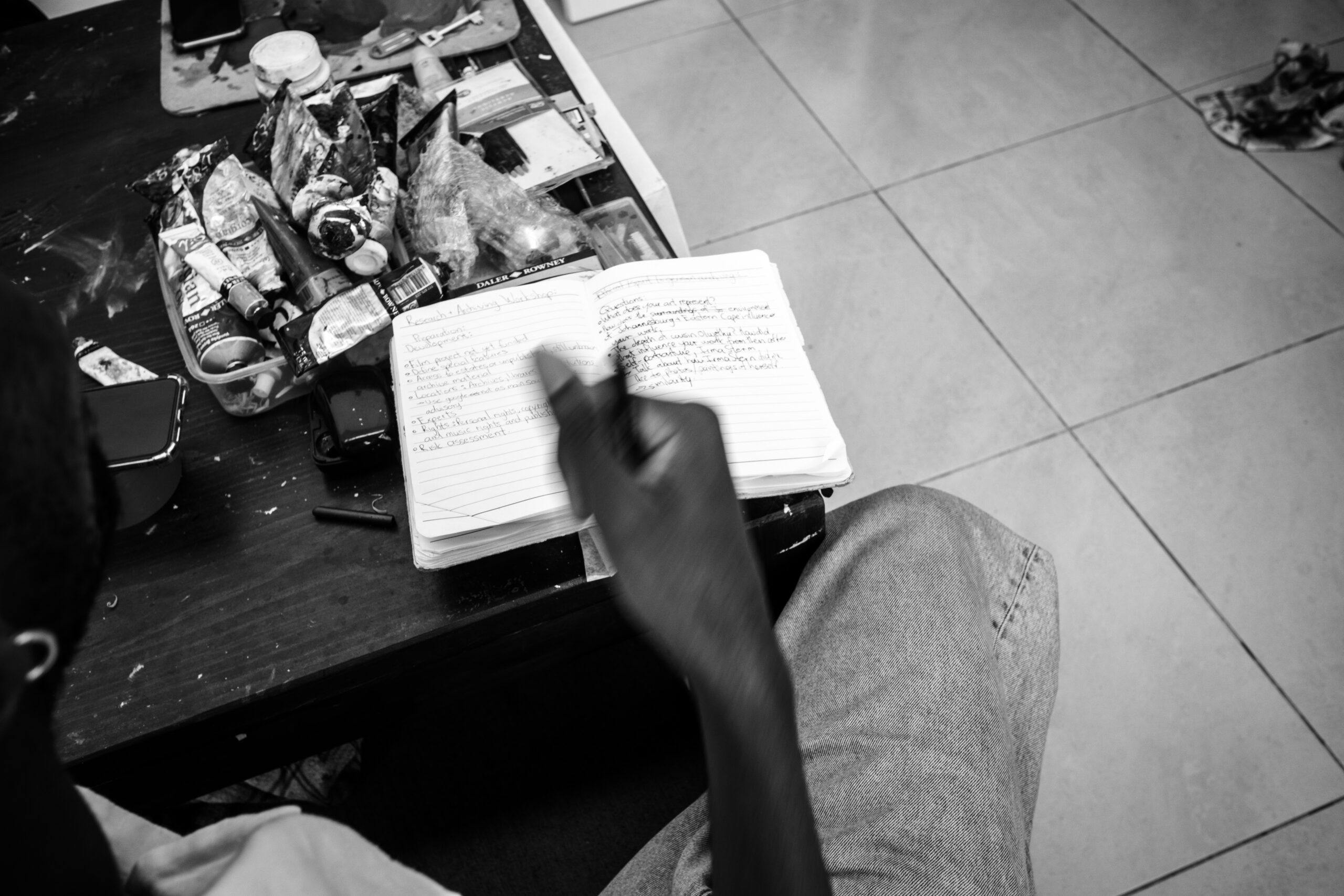
Archiving the Baddie: An interview with Sichumile Adam
The word ‘Baddie’, short for “Bad B*tch”, is a term used to describe a confident, stylish and attractive no-nonsense woman. Qualities that our third and current Artist of the Moment, Sichumile Adam, exemplifies in herself and sees in her friends and the women around her.
The term has its origins in African American Vernacular English, gaining popularity on the internet over the past decade and entering the mainstream lexicon. Its widespread use amongst young people around the world and especially in South Africa, speaks to the globalised nature of contemporary youth and pop culture. What does it mean to be a Baddie within a South African context? Is Baddie-hood something new to the South African woman?
To the second question, Sichumile Adam would probably answer: No, South African women from the past to the present have always been Baddies.
Sichumile Adam (b. 2001) is a Johannesburg-based artist who holds a honours degree in Fine Arts from the University of the Witwatersrand. Her practice is multidisciplinary and primarily uses acrylic paint, fabric and glass beads. In her work, Adam captures the contemporary cosmopolitan urban black woman. One who is rooted in her post-apartheid context but linked to and influenced by the culture and trends of the black diaspora. A social culture that is shared around the world by women who look like her. I had the pleasure of meeting and conducting this interview with Sichumile at her Johannesburg-based studio.
“I’ve always liked art. When I was younger, I used to like watching Winx Club, Bratz and Totally Spies a lot and after every episode, I’d always redraw all the characters,’’ recalls Sichumile. This early childhood experience of art-making pushed her to pursue art as a subject in high school and later, at university. “When I was watching Bratz and stuff like [that], I don’t think at that time I understood how many moving parts and how many people come together to make this thing? You know?’’
When looking back at childhood media like Bratz or Totally Spies, at the time we initially consumed them, we (as children) would not have identified the characters in these shows as “Baddies.” It’s only in retrospect, in our adulthood, that we can do such. I wondered how that experience of her redrawing cartoon characters influences her current artistic style and practice. Sichumile answers, “I had that realisation recently. I think that’s why the content we consume as kids is really important, because now I’m re-living those things as [an] adult. Like, even all of us, we’re… I don’t want to say, healing like [our] inner child, but like, we’re all curious about…things that we found entertaining as kids. And we try to bring that back into our adult life.
I think my work is very animated. And very girly. And very playful.”
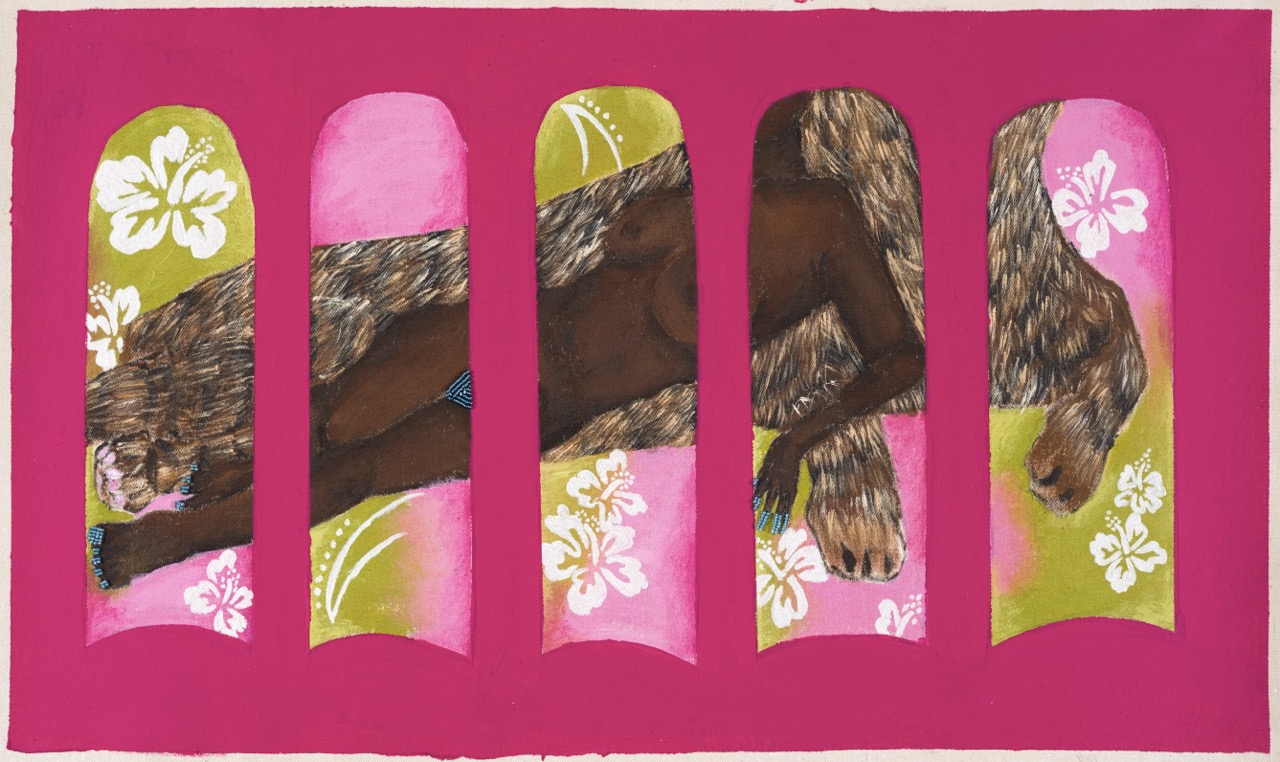
As a member of Gen Z, Sichumile would describe herself as an internet child. “We had like the best of both worlds. I had Tumblr. I had We Heart It.” With the world at her fingertips, Sichumile was able to access and consume popular trends, culture and media from across the globe. “So, in high school, I was on YouTube a lot. Like [watching] all the makeup girls, they were so fly. Literally like, that was something becoming really popular when I was 16. And I think, for me, being exposed to the internet at that time, honestly, was like heaven. Even things like Soundcloud, because I went to a high school in a very white town.” For young Sichumile, growing up and attending high school in a predominantly white town like Krugersdorp was an isolating experience for her and especially for her sense of blackness. To mediate this experience, Sichumile sought refuge via the internet. “I saw all these cool black kids on Tumblr. And like, all these cool black kids on the internet. And that’s how I got my confidence because I was like, okay, I’m not seeing this like here around me, but like this definitely exists. Even like the natural hair movement that happened. Like I saw that on the internet first and then I was like, oh wait, like black girls, they’re actually like really cool and I think that’s why I’m so like persistent on like showing black girls, like for me. Like I had that like on the internet and I just want other girls to have that, like in art. Like to walk into a gallery and like see a black girl and she is in a bikini and she has her long nails and she has blonde hair.”
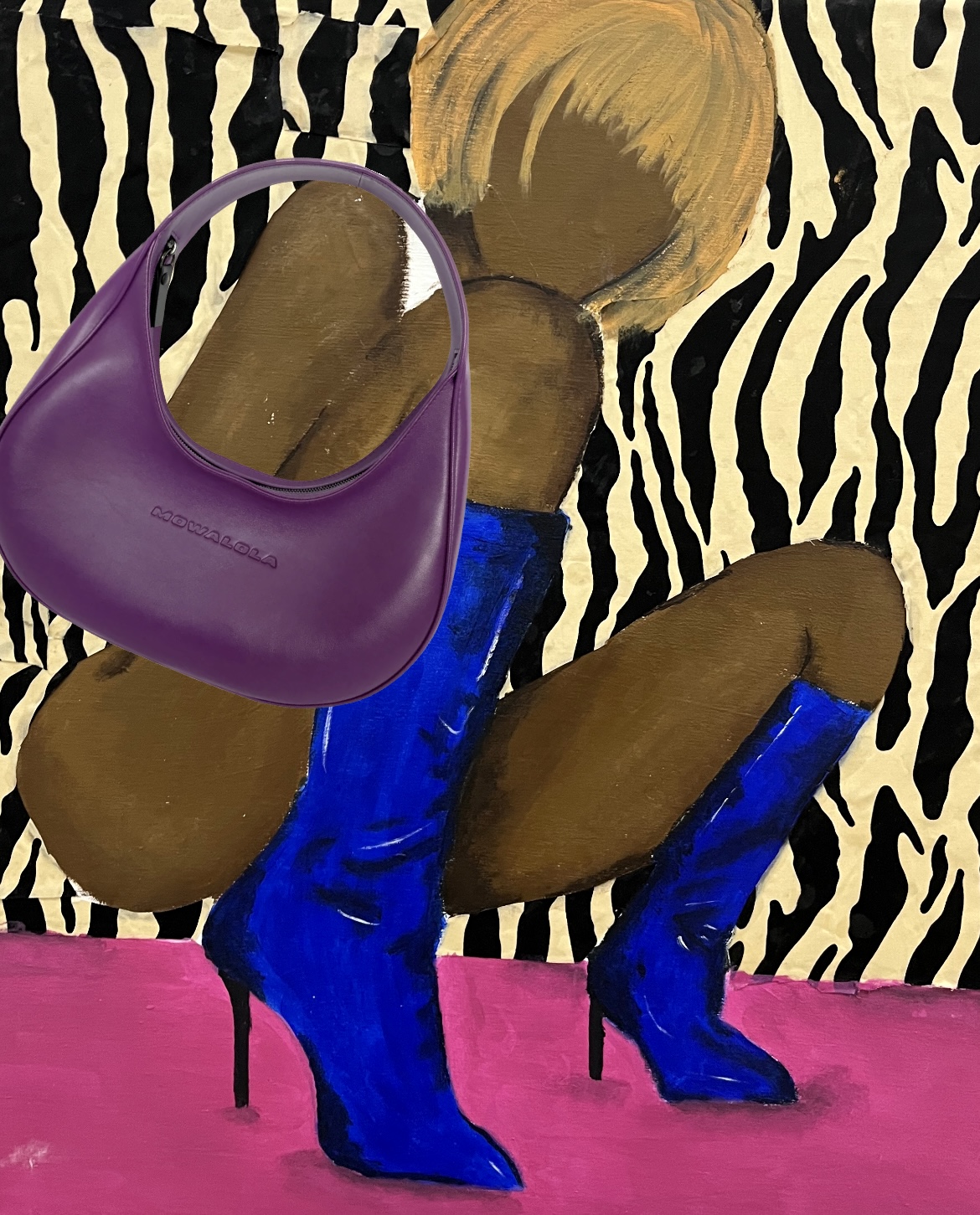
Londi x Mowalola large bundle bag | Sichumile Adam | 53cm x 60cm | Acrylic paint on canvas | 2023
This cosmopolitan black diasporic social and pop culture that Sichumile embedded herself in during her teenage years can be seen throughout her practice. From the depiction of a previous IT bag, the Mowalola bundle tote bag, in her work (pictured above), to her titling one of her works in reference to the Real Housewives of Atlanta (“Don’t Make Me Call…Porsha”) and her work ‘Baby’ (pictured below) referring to the clothing brand, Baby Phat by Kimora Lee Simmons, adorned by the main subject in the work.
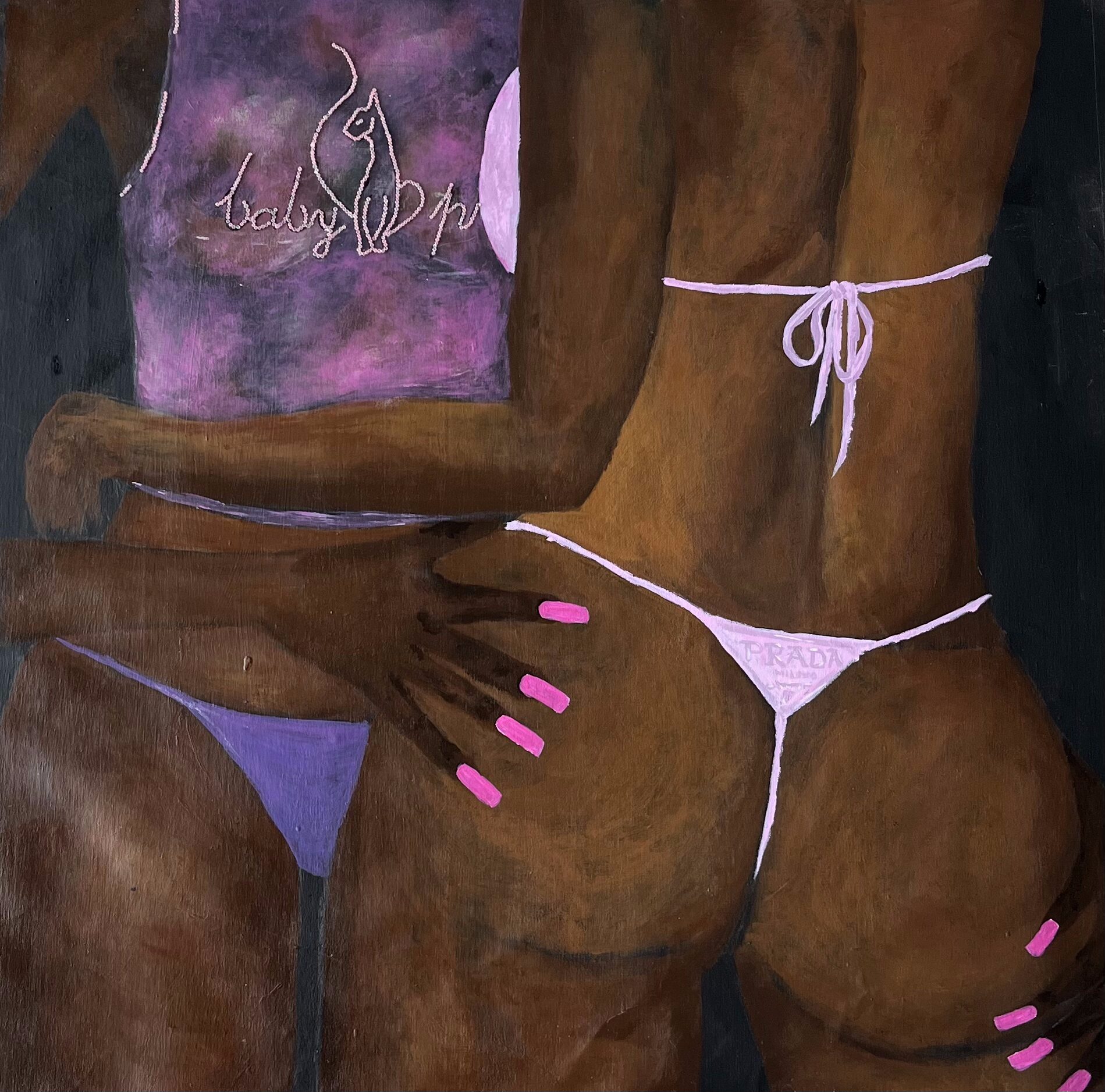
Baby | Sichumile Adam | 2024 | 63cm x 60cm | Acrylic paint and glass beads on canvas
With so many international cultural references in her practice, how does Sichumile make space for her South African reality in her work? “I’m trying to be more intentional with my work right now and [I’m] trying to locate it more within South Africa and like, bring our culture more to the forefront. So like, my work is inspired a lot from the American Internet and the UK. And I’m just trying to figure out where does a South African context come in, like where do we fit in there,” states Adam.
The type of femininity that Sichumile embodies in her personal life and practice might feel like a recent or foreign phenomenon within South Africa. But I think Sichumile would argue otherwise. During our live conversation, Sichumile spoke about some images from the 1970s that she saw at a recent show at the Javett Art Centre. “Look at this… *shows images to interviewer on cellphone* These are literal baddies. These are girls standing outside of cars in heels and then even this one, like the girl is in her jeans! And these [photos] are literally from years ago. So I’m like women looking the way that we look today, it’s not a new thing. It’s just never been documented and that’s why everyone acts
shocked. It’s like I’m pretty sure our grandmothers were wearing short skirts, respectfully.”
“…during segregation in the townships, it was very much still lively; we had things like Sophiatown. We had women singing in bars.”
For Sichumile, black South African women embodying the type of femininity that she, her friends and the women around her do is not new. In fact, black South African women have always been autonomous, outspoken and confident individuals throughout our history. The issue is the lack of (publicly available) documentation of such women in the past, which renders the story we tell ourselves about femininity and womanhood in South Africa to be rooted in conservative and patriarchal colonial ideals.
“I think modesty is a scam. It’s very patriarchal and it’s very imperialistic to be like modest, especially as African women. What is ‘modesty’? Like that’s not even a word that exists in our vocabulary.”
If you have ever read any text concerning Sichumile Adam’s artistic practice, there is a high chance that you would have seen the mentionings of the iconic DRUM magazine. For her Fine Arts honours thesis, Adam looked through the archives of the old DRUM magazine paying special attention to the covers. “I looked into the DRUM magazine and looked into the covers. And I was like, these covers back then, the cover girls that were like on the DRUM magazines. They look like every other girl that I see walking down the streets, like we literally exist, everywhere. And it’s really important to document that, like especially for the black child, because the default image of blackness in the world is quite sad.”